Ceasefire Ends Amid Renewed Hostilities
The ceasefire agreement between the United States and Iran has ended, with President Donald Trump declaring the situation as such following a series of strikes exchanged by both nations. Trump expressed distrust towards Iran's leadership, labeling them in derogatory terms, as tensions continue to rise.
Escalating Tensions
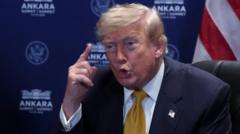
In a statement made prior to a NATO summit in Turkey, President Trump remarked that while US negotiators might continue discussions if they choose, he personally deemed such efforts as futile. The remarks led to a spike in oil prices, though they remain lower than the peak levels experienced during the complete closure of the Strait of Hormuz.
The recent exchanges, which occurred from Tuesday night into Wednesday, represent the most intense since the interim deal was struck in June. This agreement had been aimed at ceasing hostilities and ensuring safe passage through the strait.
US and Iranian Strikes
The US Central Command reported on Tuesday that it had conducted "powerful" strikes in retaliation for attacks on three tankers in the Strait of Hormuz. In response, Iran claimed to have targeted US military sites located in Bahrain and Kuwait. Additionally, the US announced the reinstatement of sanctions on Iranian oil.
Accusations of Breach
Iran's parliamentary speaker, Mohammad Bagher Ghalibaf, accused the United States of violating their Memorandum of Understanding (MoU), citing the recent attacks and other alleged breaches. He declared the end of what he described as an era of "bullying and extortion." Meanwhile, NATO chief Mark Rutte justified the American strikes as necessary, given Iran's alleged violations of the ceasefire.
Previous Conflicts and Agreements
Following the signing of the MoU on June 17, strikes had occurred. The US conducted operations on June 26 and 27 following Iranian projectiles targeting vessels in the Strait. Despite the earlier agreement to "stand down," tensions have persisted.
The MoU included a call for the "immediate and permanent termination of military operations on all fronts" and a commitment from Iran to facilitate the safe passage of commercial vessels for 60 days without charge. Negotiations were ongoing regarding a permanent resolution, but they were paused for funeral ceremonies honoring the late Ayatollah Ali Khamenei.
Future Negotiations Uncertain
The latest strikes have cast doubt on the resumption of talks. President Trump, when queried about the possibility of further negotiations, expressed little interest, suggesting it would be a "waste of time." He indicated that while negotiators like Steve Witkoff and Jared Kushner could continue efforts if desired, he personally saw no merit in doing so.
Source: Original Article