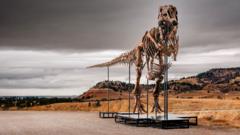
Valuable T. Rex Fossil Heads to Auction
In a significant event for both collectors and scientists, a highly complete Tyrannosaurus Rex fossil, dubbed 'Gus,' is poised to become the most expensive dinosaur fossil ever sold at auction. Valued at $30 million, the auction of Gus has ignited discussions regarding the accessibility and ownership of crucial scientific specimens.
The High Stakes of Dinosaur Fossil Auctions
Back in 1997, Sotheby’s hosted a groundbreaking auction where a T. rex named Sue was sold for $8 million to the Field Museum in Chicago. Fast forward nearly three decades, and the auction of Gus is drawing not only museum interest but also the attention of affluent private collectors. The potential sale of Gus raises pressing questions about whether such important fossils should remain exclusively in the public domain for scientific study or be available to private buyers as well.
The Risks and Rewards of Fossil Hunting
Fossil hunting is not without its challenges and dangers, as explained by Cassandra Hatton, Sotheby’s global head of natural history. Excavators often face harsh conditions and risks, from wildlife to unpredictable weather, in pursuit of these ancient treasures. Gus was discovered in the challenging terrain of South Dakota's Badlands, and the excavation process spanned several years, demonstrating the dedication and skill required to recover such specimens.
Scientific Concerns Over Private Collections
The sale of significant fossils to private collectors poses challenges for the scientific community. Professor Susannah Maidment from London’s Natural History Museum highlights the difficulties this trend presents to researchers. With prices soaring, museums often find themselves unable to compete at auctions, limiting their access to important specimens needed for study and public education.
“We’re already priced out of having access to many, many specimens,” Prof Maidment stated, emphasizing the importance of having access to actual fossils for scientific research.
The Importance of Fossils in Understanding Our Past
Palaeobiology, the study of past life forms, is crucial for understanding current and future ecological changes. With the Earth possibly undergoing a mass extinction, insights from fossils like Gus are invaluable for researchers. Fossils provide a tangible connection to the past, helping scientists and the public alike to engage with the natural world.
Balancing Scientific and Private Interests
The debate over fossil sales is complex. On one hand, auctioneers and fossil hunters argue that the high prices of rare fossils reflect their significance and the efforts required to recover them. On the other hand, scientists worry about the implications for research when access to these specimens is restricted by private ownership. The scientific community stresses the need for fossils to remain accessible for continuous study, as private collections often limit this possibility.
The Role of Philanthropy in Fossil Preservation
While some private collectors, like Kenneth Griffin who purchased the Stegosaurus 'Apex,' have loaned fossils to museums, the reliance on private philanthropy presents challenges. Scientific journals typically do not accept research based on privately held specimens, as these must be accessible for ongoing study and verification.
The Future of Fossil Conservation
The threat of a 'second extinction' of dinosaurs, through the potential loss of fossils to private collections, is a concern shared by many in the field. Despite these challenges, the work of fossil hunters remains critical in discovering and preserving these ancient records. Their efforts ensure that many specimens, large and small, continue to contribute to scientific knowledge and public interest.
Source: Original Article