Yemen Conflict Sees New Tensions
Yemen's Houthi rebels announced the launch of missiles targeting Abha airport in southwestern Saudi Arabia on Monday. This action was framed as a response to airstrikes on Sanaa's airport, which the Houthis attribute to Saudi Arabia. The Saudi-led coalition, supporting Yemen's internationally-recognized government, reported that its air defenses managed the missile threats effectively, with no casualties reported.
Background of the Escalation
The Houthis, controlling northwestern Yemen and backed by Iran, accused Saudi Arabia of aggressive actions, alleging that Saudi forces targeted the runway at Sanaa's airport. The Yemeni government, which claimed responsibility for the strikes, stated its intention was to prevent an Iranian aircraft from landing. This incident marks a notable escalation in a conflict that had seen reduced hostilities under an informal truce established four years ago.
The ongoing civil war in Yemen began in 2014 when the Houthis took control of the capital, Sanaa, displacing the government. The conflict intensified in 2015 when a coalition of Arab states led by Saudi Arabia intervened to restore the government's authority. The war has resulted in over 150,000 deaths and has created one of the most severe humanitarian crises globally, affecting more than 22 million people who require assistance, according to the United Nations.
Details of the Recent Strikes
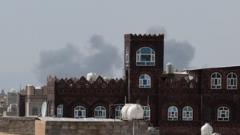
Social media footage from Monday afternoon depicted smoke clouds over Sanaa following strikes at the city's international airport. The Houthi-run al-Masirah TV reported that airport runways were specifically targeted. The Yemeni government, based in the southern city of Aden, confirmed its forces conducted the strikes over a dispute regarding the travel of a Houthi delegation returning from Iran after the funeral of Ayatollah Ali Khamenei.
The Yemeni defense ministry accused the Houthis, supported by Iran, of obstructing Yemeni national aircraft while allowing an Iranian plane to encroach on Yemeni airspace, prompting the airport's runway attack. The Iranian aircraft was redirected, eventually landing in Hudaydah, around 150km southwest of Sanaa, according to the Houthis.
International Reactions and Warnings
Houthi military spokesperson Yahya Saree blamed Saudi Arabia for the Sanaa strikes, declaring that this action ended the conflict's "de-escalation phase" and would be met with retaliation. He warned airlines to avoid Saudi airspace until the blockade on Sanaa International Airport lifts.
Saudi authorities did not immediately comment on the strikes. However, the spokesperson for the Saudi-led coalition later stated on social media that their air defenses had managed the ballistic missile threats launched by the Houthi militia towards the Southern Region.
At an emergency United Nations Security Council meeting, Assistant Secretary-General Khaled Khiari expressed concern about the renewed strikes, urging all parties to engage in UN-mediated negotiations to avoid further escalation. The UK's representative to the UN condemned the Houthi attacks on Saudi Arabia, citing threats to regional security, while Iran's foreign ministry criticized the attack on Sanaa's airport as a violation of international law.
Source: Original Article