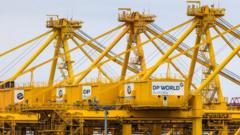
Australian Dock Workers Advocate for Reduced Hours
In response to the expanding use of artificial intelligence (AI) and automation in port operations, Australian dock workers are calling for a reduction in their work week to 28 hours, without any loss in pay. The demand arises as port logistics company DP World continues to integrate AI technologies at its facilities, a move that the Maritime Union of Australia (MUA) believes threatens job security.
The MUA has expressed concerns over the potential job losses that could result from increased automation. According to the union, if DP World wishes to implement AI and automation, they should ensure that the technology benefits workers rather than jeopardizing their employment. The union emphasized that new technological advancements should not endanger the livelihoods of employees simply to enhance company profits.
If DP World wants AI and automation, then they must pay the social dividend. The new technology shouldn't cost our members their jobs or put their livelihoods at risk just so a terminal operator can boost profits.
The BBC has reached out to both DP World and the MUA for comments regarding the ongoing negotiations.
Impact on Jobs and Work Environment
A study by the Centre For International Corporate Tax Accountability and Research, commissioned by the MUA, indicated that DP World is testing AI tools for managing employees and work schedules. This shift could potentially affect up to 60% of the dock and maintenance workforce, potentially resulting in the loss of up to a thousand jobs. In addition, the company is considering the use of AI-assisted remote-control cranes and driverless vehicles.
The union has been vocal about the need for AI to enhance, rather than detract from, the quality of workers' lives. In early July, they reiterated their call for a 28-hour work week, arguing that such a measure would offset the impacts of automation.
Current Work Schedule and Company Overview
Currently, dock workers employed by DP World reportedly work between 32 and 35 hours per week, depending on their location, as noted by the Australian Financial Review, which initially reported on the negotiations. DP World, a state-owned enterprise from Dubai, is one of the largest port operators globally, operating in 84 countries and employing over 126,000 people. The firm handles about 10% of global container traffic, moving millions of shipping containers annually through its Australian ports in cities such as Sydney and Melbourne.
DP World's operations are ultimately overseen by Dubai's ruler, Sheikh Mohammed bin Rashid Al Maktoum. The company has consistently emphasized the necessity of AI in managing complex supply chains, with Glen Hilton, DP World's Asia Pacific chief executive, stating last year that the use of such technology is now essential.
Global Implications
As DP World continues to integrate AI into its operations, the situation at Australian ports may serve as a precedent for similar discussions worldwide, where the balance between technological advancement and job security remains a critical issue.
Source: Original Article