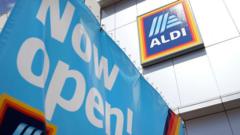
Aldi's Strategic Move into Urban Retail
Mary Porter, a long-term resident of Manhattan, recently visited the new Aldi store in her neighborhood. She discovered a $4 jar of almond butter, which was significantly cheaper than the $22 price tag in her local stores. This exemplifies the retailer's reputation for affordability, which Porter, 79, found impressive as she filled her basket with fresh produce at lower prices than usual.
The store, located in an underground parking area of The Ellery, a luxury apartment complex, is part of Aldi's ambitious $9 billion expansion plan in the US. Aiming to open 800 new stores over five years, Aldi is focusing on urban centers like Manhattan. This is a significant shift for the German supermarket chain, which has traditionally been associated with suburban locations.
Rising Competition in the Grocery Sector
Aldi's expansion strategy has led to concerns among established US grocers, as the company has successfully captured market share in the UK by offering affordable yet high-quality products. Aldi's approach has allowed it to become the fourth largest grocer in the UK, with a market share of 10.8%. This growth has been fueled by changing consumer perceptions and the economic challenges of the 2020s, prompting shoppers to seek cost-effective options.
Despite its growth, Aldi's market share in the US remains modest at 2.9%, compared to Walmart's commanding 20%. Experts suggest that Aldi's smaller size is an advantage, allowing it to target middle and upper-income consumers seeking budget-friendly shopping options. Analysts note that inflation has driven wealthier households to consider more economical grocery stores like Aldi.
Adapting to Urban Challenges
For urban shoppers, the new Aldi stores offer a more appealing experience compared to older locations. Kelvin Dozier, a regular Aldi shopper, appreciates the convenience and brighter environment of the Manhattan store compared to the smaller Brooklyn location. However, some consumers remain loyal to other retailers, such as Trader Joe's, due to Aldi's focus on private-label products, which may not meet the preferences of those seeking more organic options.
Aldi's reliance on private labels helps keep costs low, which is part of its efficient business model, providing a reduced yet sufficient range of products at competitive prices. Nonetheless, experts like Dustin York indicate that Aldi is unlikely to significantly disrupt Walmart's dominance due to the latter's vast scale and resources.
Logistical Challenges and Competitive Landscape
Operating in high-cost areas like Manhattan presents unique challenges for Aldi. The company faces high real estate costs and logistical hurdles, such as navigating narrow city streets with specialized trucks from South Windsor, Connecticut. These trucks operate at night to avoid congestion, requiring a two-person crew for efficient unloading. This complex operation is necessary to keep the Manhattan store well-stocked.
Despite these challenges, experts like Jerry Sheldon argue that Aldi cannot outpace Walmart due to the latter's substantial investments in technology and supply chain efficiency. Walmart's ability to leverage its scale and resources, including additional revenue streams from advertising and memberships, provides a significant competitive edge.
For consumers like Mary Porter, the corporate strategies are less important than the immediate savings on groceries. Porter's satisfaction with her affordable purchases reflects the appeal of Aldi's model for cost-conscious shoppers.
Source: Original Article